
In this vast expanse of the dark void of the Universe lives the grand stellar, the Constellation. It plays along the azure among the celestial bodies, the planets, the huge masses of asteroids and stars along with Mythology. Among these intricate and dazzling constellations falls the ‘brightest’ cluster of stars represented by an animal constellation.
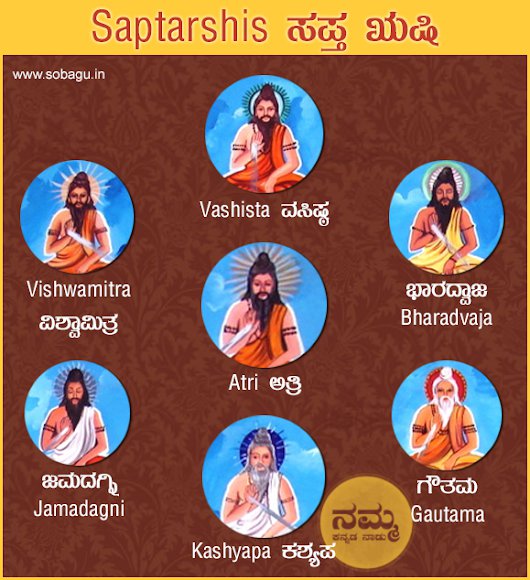
As the ‘Vishnu Purana’ proclaims: ‘When Brahma wished to populate the World, he created mind-born sons, like himself; viz. Bhrigu, Pulastya, Pulaha, Kratu, Angiras, Marichi, Daksha, Atri and Vasistha : these are the nine Brahmas or Brahma-rishis celebrated in the Puranas.’ Originally only seven are mentioned in the MAHABHARATA. These seven are supposed to be visible in the Great Bear, as their wives shine in the Pleiades. These Brahmarishis are also called Prajapatis (Lords of Offspring), Brahmaputras (Sons of Brahma) and Brahmanas.
In his account of the creation, Manu mentions ten Maharishis as having been created by himself, one of whom is Bhrigu, who in his turn created seven other Manus, from whom all that is has sprung.
Vasistha, together with Pulastya, is said to have narrated the ‘Vishnu Purana’, and he too is believed to have been the author of many of the Vedic Hymns. It was he who allayed the anger of Panasara when that sage was about to extirpate the Rakshas race, because one of their kings had slain his father. He is said to have been the Vyasa or arranger of the Vedas, in the Dvapara Age. Vasistha served as the family priest of a king named Saudasa , when out hunting , seeing a couple of tigers, shot one of them with an arrow. He had cursed the king for his offering of human flesh that the king had been ordered to prepare for a Rakshas who had come in the disguise of Vasistha for vengeance.
Marichi is better known through his descendants than from any work of his own, his most illustrious child being Kasyapa, as a son of whom Vishnu came, in his incarnation as a dwarf. The name Marichi comes from a Ray of Light from either the Moon or the Sun and Marichi is the chief of the Maruts(‘the Shining Ones’). He is the Manasa putra of the cosmic creator Brahma who created Marichi from the eyes.
Pulastya, one of Brahma’s mind-born son is reverenced because it was through him that the PURANAS were made known to men. ‘Vishnu Purana’ regards Pulastya as the Revealer of Scripture, where the narrator Paiasara, in answer to a question of his disciple Maitreya, says : ‘You recall to my mind what was of old narrated by my father’s father , Vasistha. I had heard that my father had been devoured by a Rakshas, employed by Visvamitra : violent anger seized me, and I commenced a sacrifice for the destruction of the Rakshasas; hundreds of them were reduced to ashes by the rite, when, as they were about to be entirely extirpated, my grandfather Vasistha thus spake to me : ‘Enough my child ; let thy wrath be appeased ; the Rakshasas are not culpable: thy father’s death was the work of Destiny.’
Paiasara ceased from his sacrifice, and Vasistha was pleased; then Pulastya had told him, ‘Since, in the violence of animosity, you have listened to the words of your progenitor, and exercised clemency, you shall become learned in every science. Since you have forborne, even though incensed, to destroy my posterity, I will bestow on you another boon; you shall become the author of a summary of the PURANAS, shall know the true nature of the deities, and your understanding through my favour shall be perfect and free from doubts.’ Paiasara relates the PURANA as told to him formerly by Vasistha and the wise Pulastya.’
Pulastya married Prithi, a daughter of Daksha, by whom he had a son, the sage Agastya; the Bhagatavacalls his wife Havisbhu, whose sons were Agastya and Visravas, the father of Kuvera, Ravana, and other Rakshasas.
Pulaha does not figure largely in Hindu Mythology. He married a daughter of Daksha named Kshama(Patience), by whom he had three sons, Pulaha is believed to be the fifth son who sprang from Brahma’s head. King Bharata renounced his kingdom and sought refuge in the hermitage of Pulaha. The sage worshipped Lord Shiva whose devotion had pleased the Lord himself and he manifested in the form of Pulaheswar in Varanasi.
Atri was the author of many Vedic hymns, especially those ‘praising Agni, Indra, the Asvins and the Viswadevas.’ He married Anasuya, who bore him Durvasas, the sage who was slighted by Indra. Soma, the Moon is said to proceed from the eyes of his father Atri. When this sage and his wife were old, they received a visit at their hermitage from Rama, Sita and Lakshman, who were wandering from place to place. Atri in introducing his wife to his illustrious guests, thus describes her –
‘Ten thousand years this votaress, bent
On sternest rites of penance, spent;
She, when the clouds withheld their rain,
And drought ten years consumed the plain.
Caused grateful roots and fruits to grow
And ordered Ganga here to flow;
So from their cares the saints she freed,
Nor let these checks their rites impede.
She wrought in heaven’s behalf, and made
Ten nights of one, the gods to aid.’
Anasuya then joins with her husband in welcoming the exiles to their hermitage, and, delighted with the Princess, tells her to ask a boon. As, however, Sita appeared to want nothing particular, the aged saint said –
‘My gift to-day
Thy sweet contentment shall repay:
Accept this precious robe to wear,
Of heavenly fabric, rich and rare;
These gems thy limbs to ornament,
This precious balsam sweet of scent.
O Maithil dame! this gift of mine
Shall make thy limbs with beauty shine
And, breathing o’er thy frame, dispense
It’s pure and lasting influence.
This balsam, on thy fair limbs spread,
New radiance on thy lord shall shed,
As Lakshmi’s beauty lends a grace
To Vishnu’s own celestial face.’
Angiras is famed as the author of several hymns of Rig-Veda. He first married Smriti(Memory), by whom he had four daughters, and afterwards he married Swaddha(Oblation) and Sati also Daksha’s daughters. His so-called daughters, the Pratyangirasa Richas, are thirty-five verses addressed to presiding divinities. There is some ambiguity in the use of his name; it comes from the same root as Agni, of which deity it is used as an epithet; it is also used of Agni’s father, and is the name of a son of Agneya, Agni’s daughter. Angiras is supposed to have been associated with Bhrigu in introducing fire-worship into India.
Kratu is no more widely known than Pulaha. He married Sannati(Humility), another daughter of Daksha, by whom he had ‘sixty thousand Balakhilyas, pigmy sages no bigger than the joint of the thumb; chaste, pious and resplendent as the rays of the sun.’