
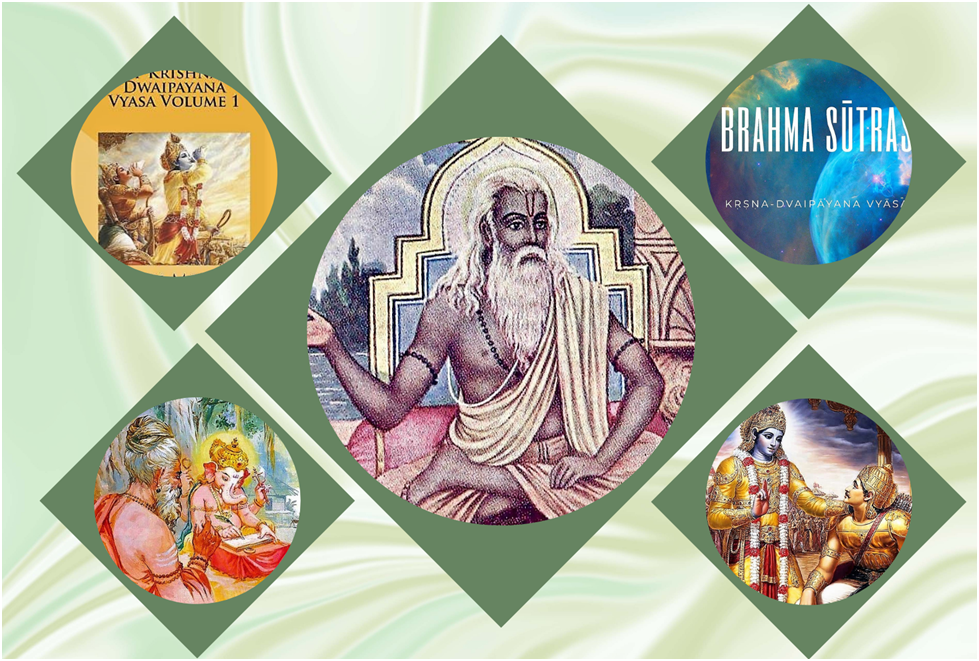
KRISHNA DVAIPAYANA VEDA VYASA
“The happiness which comes from long practice, which leads to the end of suffering, which at first is like poison, but at last like nectar – this kind of happiness arises from the serenity of one’s own mind”. – Vyasa
According to mythology, Ved Vyas, the son of Maharishi Parashar and Nishad daughter Satyavati, had gone to the island of Dvaipayana for penance as soon as he was born. It is believed that he was born on Ashadhi Purnima. Due to intense penance, he had become black and due to going for penance on Dvaipayana Island, he was called Krishna Dvaipayana. There is also a legend that he was born on an island in the middle of the river Yamuna, due to his dark complexion, he was named Krishna Dvaipayana. Krishna Dvaipayana was the 28th Veda Vyasa.
The holy Guru Purnima has an ancient traditional association with the worship of the Brahmavidya Gurus, the teachers of the Science of God, the masters who were known as Srotriyas and Brahmanishthas. A Guru is defined as a sage of perfection endowed with the two great qualifications of Srotriyatva and Brahmanishthatva—learned and also spiritually exalted. The interesting sidelight which learned men try to throw on the meaning of these two terms, ‘Srotriya’ and ‘Brahmanishtha’, is that a teacher of the science of the Spirit should be not only intellectually learned but also spiritually established. The reason for expecting these two qualifications from one person is this: While no doubt it is true and wonderful that establishment in God-consciousness is a most praiseworthy achievement of any individual, at any time; it is necessary that he should also have the apparatus to communicate this knowledge to the students, the aspirants or the disciples. This apparatus is nothing but the psychology or the knowledge of the process of teaching, which calls for a sort of learning in the scriptures and in the requirements of logical approach to things, what generally today is known as scholarship. A mere scholar would not also be an appropriate person to teach the science of the Spirit, because he should also have an experience inside. The force of conviction cannot be conveyed merely by learning, whatever be the expanse or vastness of that education. The knowledge has to come from his heart, which means to say that he should also have the insight into the reality about which he is speaking or on which he is communicating his knowledge. So, this is the meaning of the Guru being a Srotriya and a Brahmanishtha.
One of the greatest Gurus our country has known and adores even now, is the great sage Veda Vyasa, known as Krishna Dvaipayana. He is reputed not only as the author of the Mahabharata, the Brahma Sutras and the Puranas, but also as the most exemplary sage of the greatest perfection one could imagine. He was a God-man, or you may say a man-God, whose powers and knowledge were unsurpassed. He could see the past, the present and the future at one stroke. He was a person endowed with cosmic consciousness. Nothing was unknown to him, at any time, in all the realms of existence. This was the sage who blessed Sanjaya with that intuition by which he could, as if through a television, see what was happening during the course of the Mahabharata war, though he himself was not in the battle-field. Not merely that, he could even know what people were thinking in their minds. What anybody would feel and what any one was contemplating or proposing to do,—those also were known to Sanjaya by the blessing of sage Vyasa. You can imagine the extent of the realisation or Perfection which sage Vyasa attained. Mighty was his power.
There are many incidents about his greatness and power recounted in the Puranas, especially in the Mahabharata. You would not believe if you read the narration given towards the end of the Mahabharata about a great power that he exercised on a particular occasion. When the war was over and destruction wrought to the heat, the Pandavas were in their camp mourning for the death of their relatives. To console them, as it were, the great Master, Sage Vyasa, comes there and speaks a few words to the satisfaction of their hearts. “What do you want? What are you grieving for? What is your desire?” He put these questions to the Pandava brothers. And the old lady Kunti was also seated there. The lady said: “What is my desire except to see my own kith and kin.” Gandhari, the mother of the Kauravas, on the other side, also expressed the same wish. “All my children have been destroyed in war, and I have none today to call my own. O, Great Master! You know my sorrow, and what desire can I have except to have a sight of these children of mine whom I have lost for ever.” The Sage said: “You shall see all of them, do not be bothered.” Next morning, he entered the Ganga waist-deep, offered a prayer, raised both his hands and poured the Ganga water down with an invocation which brought down all the heroes from the heaven. All those dead people started rising up one by one from the waters of the Ganga. It was something marvellous to see and one could not trust one’s own eyes. Karna, Duryodhana and all others, who were no more, came up to the surface and shook hands with those seated there. And it is said that one complete night they spent together in mutual chat happily, as a fraternity in a single family. And the next morning, there was nobody! They had all vanished. We, today, cannot understand all these things, because these mysterious phenomena are beyond our understanding. Our brains cannot work. For these great men who could see the whole cosmos and all its realms of existence, there was no birth or death. Nobody was born and nobody died. Only they shifted their locations and so Masters like Vyasa could summon anybody from anywhere, just as you could write a letter to a person in Kannyakumari and request him to be here, or you can go to New York and see someone there. There is no birth or death involved in this; it is only a change of position or location. So no one is destroyed. Everybody is here and everything is just now, in one place or the other, in one form or the other; and all the heroes of ancient history are even today alive somewhere. They are not destroyed. Everything is everywhere in a most concrete form.
Such a realisation was a possession of this great Master Krishna Dvaipayana Vyasa who has given us the great message of the Mahabharata and the Bhagavad Gita. Really speaking, he should be regarded as the builder of India. The Mahabharata is nothing but Greater India, which built up the vast edifice of cultural integrity, whose centrality and core we have in the Bhagavad Gita. He is supposed to have commenced a great work called the Brahma Sutras on this sacred day,—the full-moon day in the month of Ashadha. This is the Vyasa Purnima, as it is called usually, dedicated to the great Vyasa, and incidentally dedicated to all the Gurus, because of the fact that Vyasa is considered as the Guru of all Gurus. Hence this is also called as Guru Purnima.
Veda Vyasa or “splitter of the Vedas”, the splitting being a feat that allowed people to understand the divine knowledge of the Vedas. He was one of the important historian, astronomer and philosopher of the Dwapara Yuga. Hindus traditionally hold that Vyasa categorised the primordeal single Veda into three canonical cantos and that the fourth one, known as Atharva, was recognised as Veda only much later. Hence he was called Veda Vyasa or “splitter of the Vedas”, the splitting being a feat that allowed people to understand the divine knowledge of the Vedas. The word ‘Vyasa’ means split, divide or differentiate.
Veda Vyasa was named as Dvaipayana as he was born on an island in the Yamuna near modern Kalpi in U.P. It seems when once sage Parashara, his father was crossing the Yamuna river in a boat. He took a fancy to the fisherman’s lovely daughter who was ferrying him across. To this girl, Satyavati, a son was born. He was dark complexioned like his mother so Vyasa was called Krishna too.
Vyasa inherited all the spiritual qualities of Vashishta and took to ascetic life. Vyasa is believed to be the earliest commentator on the Yoga Sutras. Though Badarayana, belonging to the fourth century is believed to be the originator of the Vedanta Sutras, the compilation of the Sutras or their arrangement is attributed to Vyasa. Krishna Dvaipayana or Vyasa collected the surviving Vedic Mantras, standardized the form and accent. Vyasa was the reputed author of the Mahabharata, the Puranas, Srimad Bhagvata and compiler of Vedas. The Puranas which are eighteen in number are believed to have been written by Vyasa. His object was to convey to the laymen the teachings of the Vedas. Each Purana is supposed to treat five principal subjects known as its Lakshanas viz. 1) the creation of the Universe 2) Its destruction 3) Principal Gods and patriarch, 4) Manvantaras or the reigns of the Manus (the fourteen world teachers), 5) The history of the two great races viz. Solar and Lunar. The Puranas are metrical compositions with occasional passages in prose.
Sage Vyasa, the compiler of the Vedas, composed the saga of the Mahabharata. It is regarded by the Hindus as “the fifth Veda”. Vyasa is traditionally known as the author of this epic and likewise features as an important character in it. It is said that he was the expansion of Lord Vishnu Himself who came in Devprayaga to make all the Vedic knowledge available in written form which was available in spoken form at that time.
In the first book of the Mahabharata, it is described that Vyasa asked Lord Ganesh to aid him in writing the texts, but Ganesh imposed a condition that he would do so only if Vyasa narrated the story without the pause. To which Vyasa then made a counter condition that Ganesh must understand the verse before he transcribed it. Thus Vyasa narrated the entire Mahabharata and all the Upanishads and the eighteen Puranas while Lord Ganesh wrote.
While Vyasa is credited with the writing of the eighteen major Puranas, his son Shuka is the narrator of the major Purana, the Bhagvat Purana. Vyasa is supposed to have meditated and authored the Epic by the foothills of the river Beas in the Punjab region. Vyasa is credited for his commentary on the Yoga Sutras of Patanjali also.
Veda Vyasa’s Mahabharata was a masterpiece. He had witnessed during his lifetime the complete events and lives of the Pandavas and Kauravas. He moralised the story by showing the triumph of righteousness over wickedness. He saw the role of Lord Krishna as God incarnate and conveyed to mankind the gem of His message through the immortal Bhagvad Gita.
The Mahabharata written by Vyasa was elaborated by his pupil Vaishsmpayana who is said to have recited it at the snake-sacrifice of King Janmejaya in the presence of Vyasa himself. Vyasa it seems once said: “Wherever there is Sri Krishna there is Dharma.” Similarly Lord Krishna had said to Arjuna: “Among the sages Vyasa is Me.”
The Puranas aptly call Vyasa the Manu of this Age and India’s true architect and guide. Sage Vyasa being the embodiment of wisdom and knowledge all sought his advice. Vyasa had advised Bhimasena that if he kept a single day fast of Nirjalaekadasi (Waterless Eleventh) , he would gain as much merit as by observing all other fasts.
Sage Vyasa founded a vast forest University which came to be known as Brahmarshidesha. His ascetic and brilliant son Shuka with his four disciples, Srimantu, Jaimini, Paila and Vaishampayana, all great rishis themselves, assisted Vyasa in building up a great tradition of learning. Vyasa visited other sacred places in Brahmavarta to spread learning and increase his own spiritual knowledge. At Badrinath, near Kesava Prayag, the holy confluence of the Saraswati and the Alaknanda, is the cave where he sat for penance. Vyasa’s father, Parashara came to know that a child, conceived at a particular moment of time, would be born as the greatest man of the age as a part of Lord Vishnu himself. On that eventful day, Parashara was traveling in a boat and he spoke to the boatman about the nearing of that auspicious time. The boatman had a daughter who was awaiting marriage. He was impressed with the sanctity and greatness of the sage and offered his daughter in marriage to Parashara. Vyasa was born of this union and his birth is said to be due to the wish of Lord Shiva, who blessed the birth the sage of the highest order. At a very tender age, Vyasa revealed to his parents the purpose of his life — that he should go to the forest and practice ‘Akhanda Tapas’ or continuous penance. At first, his mother did not agree but later approved on one important condition that he should appear before her whenever she wished for his presence. According to the Puranas, Vyasa took initiation from his guru sage Vasudeva. He studied the Shastras or scriptures under the sages Sanaka and Sanandana and others. He arranged the Vedas for the good of mankind and wrote the Brahma Sutras for the quick and easy understanding of the Shrutis; he also wrote the Mahabharata to enable common people to understand the highest knowledge in the easiest way. Vyasa wrote the 18 Puranas and established the system of teaching them through ‘Upakhyanas’ or discourses. In this way, he established the three paths of Karma, Upasana (devotion) and Jnana (knowledge). Vyasa’s last work was the Bhagavatam which he undertook at the instigation of Devarshi Narada, the celestial sage, who once came to him and advised him to write it, without which, his goal in life would not be reached.
In ancient times, our forefathers in India, went to the forest to meditate during the four months or ‘Chaturmasa’ following Vyasa Purnima—a particular and important day in the Hindu calendar. On this auspicious day, Vyasa began to write his Brahma Sutras. This day is also known as Guru Purnima when, according to the scriptures, Hindus should worship Vyasa and the Brahmavidya Gurus and begin the study of the Brahma Sutras and other ancient books on ‘wisdom’. The Brahma Sutras, also known as the Vedanta Sutras is believed to have been written by Vyasa along with Badarayana. They are divided into four chapters, each chapter being subdivided again into four sections. It is interesting to note that they begin and end with Sutras which read together mean “the inquiry into the real nature of Brahman has no return”, pointing to “the way one reaches Immortality and no more returns to the world.” About the authorship of these Sutras, tradition attributes it to Vyasa. Sankaracharya refers to Vyasa as the author of the Gita and the Mahabharata, and to Badarayana as the author of the Brahma Sutras. His followers—Vachaspathi, Anandagiri, and others—identify the two as one and the same person, while Ramanuja and others attribute the authorship of all three to Vyasa himself.
Vyasa is considered by Hindus as Chiranjivi or immortal, one who is still living and walking the earth for the well-being of his devotees. It is said that he appears to the true and the faithful and that Adi Sankaracharya had his darshan as did many others as well. Vyasa’s life is a unique example of one born for the dissemination of spiritual knowledge. His writings inspire us and the whole world even to this day in innumerable ways.
According to legend, in a previous life Vyasa was the Sage Apantaratamas, who was born when Lord Vishnu uttered the syllable “Bhu”. He was a devotee of Lord Vishnu. Since birth, he already possessed the knowledge of the Vedas, the Dharmashastras and the Upanishads. At Vishnu’s behest, he was reborn as Vyasa.
Vyasa was the son of Sage Parashara and great grandson of Sage Vashistha. Prior to Vyasa’s birth, Parashara had performed a severe penance to Lord Shiva. Shiva granted a boon that Parashara’s son would be a Brahmarshi equal to Vashistha and would be famous for his knowledge. Parashara begot Vyasa with Satyavati. She conceived and immediately gave birth to Vyasa. Vyasa became an adult and left, promising his mother that he would come to her when needed. Vyasa acquired his knowledge from the four Kumaras, Narada and Lord Brahma himself.
Vyasa is believed to have lived on the banks of Ganga in modern-day Uttarakhand. The site was also the ritual home of the sage Vashishta, along with the Pandavas, the five brothers of the Mahabharata.
According to the Mahabharata, the sage Vyasa was the son of Satyavati and Parashara. During her youth, Satyavati was a fisherwoman who used to drive a boat. One day, sage Parashara was in a hurry to attend a Yajna. Satyavati helped him cross the river borders. Parashara was enchanted by the beauty of Satyavati and wanted his heir from her. Initially she did not agree to his demand telling that other saints would see them, and her purity would be questioned. So Parashara created a secret place with bushes and Satyavati agreed. Satyavati later gave birth to Vyasa. Parashara took away Vyasa with him when he was born. She kept this incident a secret, not telling even King Shantanu whom she was married to later.
After many years, Shantanu and Satyavati had two sons, named Chitrangada and Vichitravirya. Chitrangada was killed by Gandharvas in a battle, while Vichitravirya was weak and ill all the time. Satyavati then asked Bhisma to fetch queens for Vichitravirya. Bhishma attended the swayamvara conducted by the king of Kashi (present-day Varanasi), and defeated all the kings. Amba openly rebuted the swayamvara as she was in love with the prince of shalva, which was against the rule of swayamvara. Later bhishma came to know that King of Kashi did not know about the love of his elder daughter, so Bhishma released Amba and allowed her to go to Shalva kingdom and marry the prince who later rejected her. She came back to Bhishma and asked him to marry her, which he could not due to his vow of lifelong celibacy. She shuttled between Bhishma and Shalva with no success. Due to this she vowed to kill Bhishma. During the wedding ceremony, Vichitravirya collapsed and died. Satyavati was clueless on how to save the clan from perishing. She asked Bhishma to marry both the queens, who refused citing his vow and the promise that he made to her and his father, never to marry. He, therefore, could not father an heir to the kingdom. Later, Satyavati revealed to Bhishma, secrets from her past life and requested him to bring Vyasa to Hastinapur.
Sage Vyasa had a fierce personality and a bright, glowing spiritual aura around him. Hence upon seeing him, Ambika who was rather scared shut her eyes, resulting in their child, Dhritarashtra, being born blind. The other queen, Ambalika, turned pale upon meeting Vyasa, which resulted in their child, Pandu, being born pale. Alarmed, Satyavati requested that Vyasa meet Ambika again and grant her another son. Ambika instead sent her maid to meet Vyasa. The duty-bound maid was calm and composed; she had a healthy child who was later named Vidura.
While these are Vyasa’s sons, another son Shuka, born of his wife Pinjalā (Vatikā), daughter of the sage Jābāli was his true spiritual heir. Shuka appears occasionally in the story as a spiritual guide to the young Kuru princes.
Hindus traditionally hold that Vyasa categorised the primordial single Veda into three canonical collections and that the fourth one, known as Atharvaveda, was recognized as Veda only very much later. Hence he was called Veda Vyasa, or “Splitter of the Vedas,” the splitting being a feat that allowed people to understand the divine knowledge of the Veda. The word vyasa means split, differentiate or describe.
The Vishnu Purana has a theory about Vyasa. The Hindu view of the universe is that of a cyclic phenomenon that comes into existence and dissolves repeatedly. Each cycle is presided over by a number of Manus, one for each Manvantara, that has four ages, Yugas of declining virtues. The Dvapara Yuga is the third Yuga. The Vishnu Purana (Book 3, Ch 3) says:
In every third world age (Dvapara), Vishnu, in the person of Vyasa, in order to promote the good of mankind, divides the Veda, which is properly but one, into many portions. Observing the limited perseverance, energy and application of mortals, he makes the Veda fourfold, to adapt it to their capacities; and the bodily form which he assumes, in order to effect that classification, is known by the name of Veda-vyasa. Of the different Vyasas in the present Manvantara and the branches which they have taught, you shall have an account. Twenty-eight times have the Vedas been arranged by the great Rishis in the Vaivasvata Manvantara… and consequently eight and twenty Vyasas have passed away; by whom, in the respective periods, the Veda has been divided into four. The first… distribution was made by Svayambhu (Brahma) himself; in the second, the arranger of the Veda (Vyasa) was Prajapati… (so on up to twenty-eight).
As per Vishnu Purana, Guru Drona’s son rishi Aswatthama will become the next sage (Vyasa) and will divide the Veda in 29th Mahayuga of 7th Manvantara.
Vyasa is traditionally known as the chronicler of this epic and also features as an important character in Mahābhārata, Vyasa asks Ganesha to assist him in writing the text. Ganesha imposes a precondition that he would do so only if Vyasa would narrate the story without a pause. Vyasa set a counter-condition that Ganesha understand the verses first before transcribing them. Thus Vyasa narrated the entire Mahābhārata and all the Upanishads and the 18 Puranas, while Lord Ganesha wrote.
Vyasa’s Jaya (literally, “victory”), the core of the Mahabharata, is a dialogue between Dhritarashtra (the Kuru king and the father of the Kauravas, who opposed the Pāndavas in the Kurukshetra War) and Sanjaya, his adviser and charioteer. Sanjaya narrates the particulars of the Kurukshetra War, fought in eighteen days, chronologically. Dhritarashtra at times asks questions and expresses doubts, sometimes lamenting, fearing the destruction the war would bring on his family, friends and kin.
Sanjaya, in the beginning, gives a description of the various continents of the Earth and numerous planets, and focuses on the Indian subcontinent.[citation needed] Large and elaborate lists are given, describing hundreds of kingdoms, tribes, provinces, cities, towns, villages, rivers, mountains, forests, etc. of the (ancient) Indian subcontinent (Bhārata Varsha). Additionally, he gives descriptions of the military formations adopted by each side on each day, the death of individual heroes and the details of the war-races. Eighteen chapters of Vyasa’s Jaya constitute the Bhagavad Gita, a sacred text in Hinduism. Thus, the Jaya deals with diverse subjects, such as geography, history, warfare, religion and morality.
The final version of Vyasa’s work is the Mahābhārata. It is structured as a narration by Ugrasrava Sauti, a professional storyteller, to an assembly of rishis who, in the forest of Naimisha, had just attended the 12 year sacrifice known as Saunaka, also known as Kulapati.
Vyasa means ‘compiler’. It is a title given to Sage Krishna Dvaipayana because he is the one who collected all the knowledge that was available at that time and classified it into four texts called the VEDAS. Bhagavan Vyasa is also recognised as an avatar of Lord Vishnu. Vyasa’s father was Sage Parashara who represents Spiritual Knowledge (Jnana). His mother was a fisher-woman and hence she represents Activity (Karma). Her name was Matsyagandhi (fish-smelling) representing ego and ego-centric activities. By the grace of Sage Parashara, she became Sugandhi (beautiful fragrance) which stands for selfless activities. Hence Veda Vyasa is a unique combination of Adhyatma Jnana and Niskama Karma. Veda Vyasa is both, a visionary and missionary. Bhagavan Veda Vyasa’s contribution is unparalleled. He gave to us the Brahma-sutras, Vedas (Sruti – Upanishads), Bhagavad Geeta (Smriti – Mahabharata), Puranas (Srimad Bhagavatham etc.). The various Geetas, Sahasranamas and many of the Stotras which we are familiar with, are all a part of the Puranas. Bhagawan Veda Vyasa is associated with almost every branch of knowledge known to us, and therefore it is a tradition to invoke his grace and blessings before the study of any scriptural text. Hence Guru Purnima is recognized as Vyasa Purnima.
Guru Purnima is celebrated on the full-moon day in the month of Ashada. Shad means ‘to sit’. Ashada means the opposite of it – it denotes restlessness. Ashada also indicates the windy month. Even when everything is fine in our lives, there comes a stage in our life, when the mind starts to feel a sense of incompleteness, an unknown restlessness which is inexplicable. There is an inner yearning for something higher. This is the auspicious time when the Guru enters our life. There is one more interpretation. Aashada with elongated ‘Aa’. This means ‘to sit along with’. When the Guru enters one’s life, the seeker should constantly remain in tune with the Guru and his teachings. And it is in the month of Ashada that all the masters undertake the Chaturmasya Vrata wherein the Acharyas who are on the move stay in one place for the benefit of the people and initiate them into the spiritual knowledge.
The word GURU is made up of GU and RU. GU means ‘ignorance’ and RU means ‘to remove’. Therefore, GURU means ‘one who removes our ignorance’. GU means ‘Gunatita’ and RU means ‘Rupatita’. Therefore GURU also means ‘one who transcended the world of forms (and names) and attributes. The two-lettered word GURU is the king among the mantras (Mantra Raja). GURU symbolises the essence of the Srutis, Smritis and Puranas. GURU is the Lord Himself who comes down to help us and guide us on the spiritual path.
On the full moon (Purnima) day, the sun and the moon are directly facing each other without the earth intervening in between. The light of the sun which represents Spiritual Knowledge is completely available for the moon which symbolizes our mind. This sunlight (knowledge) is completely converted into moonlight (divine inner experience). Therefore, the full moon endowed with all its sixteen parts or kalas represents the full (Purna) state of the Guru. The earth which is not intervening between the sun and the moon represents the transcendence of the ego. Hence the Purnima day is celebrated as Guru Purnima. On this auspicious day, we invoke the grace and blessings of the entire Guru-Sishya Parampara starting from Sri Dakshinamurthy, the Guru of all Gurus, Bhagavan Veda Vyasa, Sri Sankara Bhagavadpada, and up to our own immediate Spiritual Guru.
The Guru’s divine form is the support in our meditation. The lotus feet of the Guru represents the altar for our upasana and worship. The Guru’s words are verily the sacred mantra. It is the Guru’s grace which bestows liberation or mukti to the seeker.
Vyasa was supposed to have been born in Treta-yuga and lived through Dwapara Yuga and at least till the early part of Kaliyuga as written in the accounts of his meeting with Adi Shankaracharya in Shankara Digvigya. Therefore, he is considered an Immortal or at least as a Chiranjeevi (long living) in Hindu tradition.
As recorded in Vishnu Purana, the main purpose for which Vyasa took birth was to arrange and transmit the Vedas. According to Bhagavata Purana (1.4.17-22), Vyasa realized that most people in Kaliyuga will be incapable of learning Vedas in its vast wholeness, and hence he arranged the Vedas into four portions.
He imparted Rigveda to Paila Rishi, Yajurveda to Vaishampayana, Samaveda to Jaimini, and Atharvaveda to Angirasa. Vyasa further taught Puranas and Itihasas (historical records) to Romaharshana. Therefore, whatever portions of Vedas we have with us today, whatever that has survived the onslaught of Kali-yuga, it is only due to the efforts of Veda Vyasa.
But, Vyasa did not stop with arranging Vedas. He realized that in Kaliyuga, most people won’t be able to even understand the divided Vedas because of the corruption and deterioration of this age. He realized that the only way that he can help mankind is by writing History and Puranas wherein the truths of Vedas would also be embedded in a simple language. Therefore, he composed Mahabharata and eighteen major Puranas including the famous Bhagavata Purana.
Through Mahabharata and Puranas, Vyasa has made the historical truths as well as the teachings of Vedas available to common people, even the illiterate ones. There are innumerable stories, histories and anecdotes that serve as life-teachings. It further provide details about various solutions to problems, various procedures for worship that will help one and all. Puranas also serve as documents of Bhakti and help those who wish to practice Bhakti. Vyasa further composed Brahma-sutras, where-in he explained the gist of the Upanishads for the sake of those people who desire Moksha.
Hence, Veda Vyasa has single-handedly managed to save, revive and propagate Sanatana Dharma. Therefore on the occasion of Guru-Purnima, every person must remember and express his gratitude towards this great Rishi.
As the day of Guru-Puja or worship of one’s preceptor this is a day of pure joy to the sincere aspirant. Thrilled by the expectation of offering his reverent homage to the beloved Guru, aspirant awaits this occasion with eagerness and devotion. It is the Guru alone that breaks the binding cords of attachment and releases the aspirant from the trammels of earthly existence. The Sruti says: “To that high-souled aspirant, whose devotion to the Lord is great and whose devotion to his Guru is as great as that to the Lord, these secrets explained, become illuminated.” Guru is Brahman or Isvara Himself. He guides and inspires you from the innermost core of your being. He is everywhere.
Behold the Entire Universe as Guru-Svarupa
Have a new angle of vision. Behold the entire universe as Guru-Svarupa. See the guiding hand, the awakening voice, the illumining touch of the Guru in every object in this Creation. The whole world will now stand transformed before your changed vision. The Virat Guru will reveal all the precious secrets of life and bestow wisdom. The Supreme Guru, manifest in visible Nature, will teach you the most valuable lessons of life. Worship daily this Guru of Gurus, the Guru who taught even Avadhuta Dattatreya. The silent all-enduring earth with its lofty forbearance, the shady fruit-bearing tree with its willing self-sacrifice, the mighty Banyan tree (Pipal) reposing with patience in the tiny seed, the dripping drops whose persistence wears away the rocks, the planets and the seasons with their orderly punctuality and regularity are divine Gurus to him who will look, listen and receive.
Purify and Progress
Become a personification of receptivity. Empty yourself of your petty ego-sense. All the treasures locked up in the bosom of Nature will become yours! You will have progress and perfection in an amazingly short time. Become pure and unattached as the mountain breeze. As the river flows continuously, steadily and constantly towards its goal, the ocean, by moving every moment of your life towards the Supreme State of Existence-Knowledge-Bliss, let all your thoughts, all your words, all your actions will be directed only towards the Goal.
The moon shines by reflecting the dazzling light of the sun. It is the full-moon of Purnima-Day that reflects in full splendor the glorious light of the sun. It glorifies the sun. Purify yourself through the fire of service and Sadhana, and like the full moon, reflect the glorious Light of the Atman. Become the full reflectors of Brahmic splendor, the Light of lights. Make this your goal, to become a living witness to Divinity, the brilliant Sun of suns!
Tat Tvam Asi
Brahman or the Supreme Self alone is real. He is the Soul of all. He is All in all. He is the Essence of this universe. He is the Unity that never admits of a duality under all the varieties and diversities of nature. Thou art this immortal, all-pervading, all-blissful Brahman. Thou art That-Tat Tvam Asi. Realize this and be free.